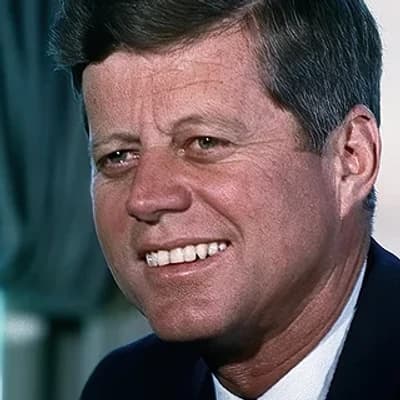
John F. Kennedy
Children of John Kennedy (in birth order)
Full list with photos →Biography
Early Life
John Fitzgerald Kennedy was born on May 29, 1917, in Brookline, Massachusetts, the second of nine children born to Joseph P. Kennedy Sr. and Rose Fitzgerald Kennedy. He grew up in a household that combined great wealth with intense competition — his father demanded excellence and his mother instilled Catholic discipline and a love of history.
Kennedy was a sickly child, suffering from numerous ailments including scarlet fever, colitis, and what was later diagnosed as Addison's disease, a disorder of the adrenal glands. Despite chronic pain that would follow him throughout his life, he learned early to project vigor and charm. He attended the Canterbury School briefly before transferring to Choate Rosemary Hall in Connecticut, where he was a middling student but enormously popular. He graduated from Harvard in 1940, where his senior thesis — an analysis of British unpreparedness for war — was published as the book Why England Slept.
Military Service
Kennedy enlisted in the U.S. Navy in 1941 and was assigned to command a torpedo boat, PT-109, in the Pacific theater. On August 2, 1943, a Japanese destroyer cut PT-109 in half near the Solomon Islands. Kennedy led the survivors through miles of open water to a nearby island, towing one badly burned crewman by clenching the man's life jacket strap in his teeth. After four days, a rescue was arranged with the help of local islanders carrying a message Kennedy carved into a coconut shell.
The incident made him a genuine war hero, and the story — told and retold during his political career — became one of the defining narratives of his public image. His older brother Joseph Jr. was killed in action in August 1944, shifting the family's presidential ambitions entirely onto John.
Congressional Career
Kennedy returned from the war a celebrity of sorts and entered politics in 1946, winning election to the U.S. House of Representatives from Massachusetts's 11th congressional district. He served three terms in the House, building his name recognition while struggling with health problems that frequently hospitalized him.
In 1952 he ran for Senate against the incumbent Republican Henry Cabot Lodge Jr., defeating him in what was considered an upset in a year when Republicans swept much of the country behind Eisenhower's presidential landslide. During his Senate years Kennedy wrote — with significant assistance from aide Theodore Sorensen — Profiles in Courage, a collection of essays about senators who defied popular opinion to follow their conscience. The book won the Pulitzer Prize for Biography in 1957, though the extent of Kennedy's own authorship has been debated ever since.
The 1960 Presidential Race
Kennedy announced his candidacy for the Democratic presidential nomination in January 1960. He faced a crowded field that included Senate Majority Leader Lyndon B. Johnson of Texas and two-time nominee Adlai Stevenson. Kennedy's campaign was methodically organized by his brother Robert, who served as campaign manager, and bankrolled extensively by his father.
The question of Kennedy's Catholicism loomed large. No Catholic had ever been elected president, and Al Smith's 1928 defeat remained a fresh memory. Kennedy addressed the issue directly in a September speech to a gathering of Protestant ministers in Houston, Texas, arguing that his private faith would not govern his public office. The speech is widely regarded as one of the most effective in American political history.
In the general election against Vice President Richard Nixon, Kennedy benefited enormously from four nationally televised debates — the first in American presidential history. Viewers who watched on television generally believed Kennedy had won; radio listeners tended to score it for Nixon. Kennedy won the popular vote by fewer than 115,000 votes out of nearly 69 million cast, one of the narrowest margins in history, and carried the Electoral College 303 to 219.
The Kennedy Presidency
Kennedy was inaugurated on January 20, 1961, delivering one of the most celebrated speeches in American history: 'Ask not what your country can do for you — ask what you can do for your country.' At 43, he was the youngest elected president in American history and the first born in the twentieth century.
His presidency was defined by Cold War confrontation. Three months in, he approved the disastrous Bay of Pigs invasion — an attempt by CIA-trained Cuban exiles to overthrow Fidel Castro — which collapsed immediately and publicly humiliated his administration. The following year brought the most dangerous nuclear standoff in history: the Cuban Missile Crisis of October 1962. For thirteen days, after U.S. surveillance aircraft discovered Soviet nuclear missiles being installed in Cuba, the world teetered on the edge of nuclear war. Kennedy rejected his military advisers' calls for airstrikes and instead imposed a naval blockade, opening secret back-channel negotiations that ultimately resulted in the Soviets removing the missiles in exchange for a U.S. pledge not to invade Cuba and a quiet removal of American Jupiter missiles from Turkey.
On civil rights, Kennedy moved cautiously at first, reluctant to alienate Southern Democrats. But the eruption of violent resistance to peaceful protests in Birmingham, Alabama in the spring of 1963 — with fire hoses and police dogs turned on demonstrators including children — forced his hand. On June 11, 1963, he addressed the nation in an unscheduled speech, calling civil rights 'a moral issue as old as the Scriptures and as clear as the American Constitution,' and announcing a comprehensive civil rights bill. The bill would not become law until after his death.
Assassination
On November 22, 1963, President Kennedy was riding in a presidential motorcade through Dealey Plaza in Dallas, Texas, when he was shot and killed. He was pronounced dead at Parkland Memorial Hospital at 1:00 p.m. local time. He was 46 years old. Lee Harvey Oswald was arrested later that day for the killing and the murder of a Dallas police officer, but was himself shot and killed two days later by nightclub owner Jack Ruby before he could stand trial.
The Warren Commission, established by President Lyndon Johnson to investigate the assassination, concluded in 1964 that Oswald acted alone. However, a 1979 congressional investigation suggested the possibility of a conspiracy, citing acoustic evidence later disputed by subsequent experts. More than sixty years later, the assassination continues to generate debate, though the core finding — that Oswald fired the shots that killed Kennedy — has not been seriously challenged.
Legacy
Kennedy governed for only 1,037 days, making any assessment of his legacy inherently speculative — a presidency defined as much by what might have been as by what was accomplished. The achievements were real: the negotiation of the Partial Nuclear Test Ban Treaty, the creation of the Peace Corps and the Alliance for Progress, the launch of the Apollo program, and the steady management of nuclear crisis.
But Kennedy's historical reputation was also shaped by the contrast between his private conduct and his public image. Revelations in subsequent decades about the extent of his extramarital affairs — including with women connected to organized crime figures — complicated the picture of Camelot that Jackie Kennedy famously promoted. His health problems, which were concealed from the public throughout his presidency, also raised retrospective questions about the integrity of his administration's public statements.
What is undeniable is the cultural impact of his death. The assassination of JFK marked a kind of fracture in American optimism, the end of a brief moment when the country believed its youngest president might guide it through the Cold War with grace and intelligence intact. His image — young, handsome, witty, cut down before his time — has proven among the most durable in American political mythology.
Family Context
John F. Kennedy is the late child of Joseph P. Kennedy Sr. and Rose Fitzgerald. They married Jacqueline Bouvier and had 4 children: Arabella Kennedy, Caroline Kennedy, John F. Kennedy Jr., Patrick Bouvier Kennedy.
Related Kennedys
Frequently Asked Questions
How did JFK die?
President Kennedy was assassinated on November 22, 1963, while riding in a presidential motorcade through Dealey Plaza in Dallas, Texas. He was struck by two rifle shots and pronounced dead at Parkland Memorial Hospital at 1:00 p.m. Lee Harvey Oswald was arrested as the suspect but was killed two days later by Jack Ruby before standing trial.
What did JFK accomplish as president?
Kennedy's major accomplishments included successfully resolving the Cuban Missile Crisis through diplomacy rather than military force, negotiating the Partial Nuclear Test Ban Treaty with the Soviet Union, creating the Peace Corps, launching the Apollo moon program, and introducing landmark civil rights legislation (which was passed after his death as the Civil Rights Act of 1964). He also established the Alliance for Progress to promote economic development in Latin America.
How old was JFK when he was assassinated?
John F. Kennedy was 46 years old when he was assassinated on November 22, 1963. He had turned 46 on May 29, 1963, just six months before his death. At 43, he had been the youngest person ever elected to the presidency.