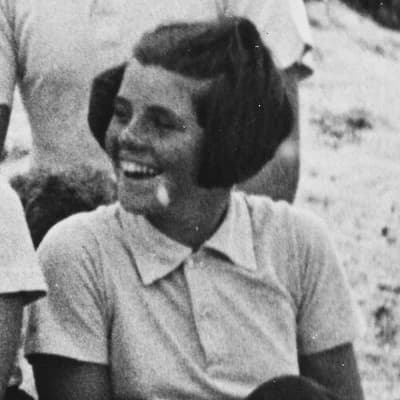
Rosemary Kennedy
Biography
Early Life
Rose Marie 'Rosemary' Kennedy was born on September 13, 1918, in Brookline, Massachusetts, the third child and eldest daughter of Joseph P. Kennedy Sr. and Rose Fitzgerald Kennedy. Medical accounts suggest that a nurse, concerned about the absence of Rose Kennedy's doctor during delivery, held Rosemary in the birth canal for an extended period, and that oxygen deprivation during that delay may have contributed to the intellectual disability that became apparent in her early years.
As a child, Rosemary struggled academically and socially in ways that distinguished her from her highly competitive siblings. She was slow to walk, slow to read, and unable to keep pace with the academic and athletic expectations that defined Kennedy family life. Her parents, particularly her mother, worked to include her in family activities and enrolled her in a variety of schools seeking approaches that might help her.
Growing Up Kennedy
Despite her difficulties, Rosemary was, by accounts of those who knew her, a warm and often joyful presence — fond of dancing, swimming, and the social occasions that filled Kennedy family life. She attended the Assumption Convent in England briefly during her father's ambassadorship in 1938–1939, and by the late 1930s she had reached a level of function that allowed her to participate in the family's busy social schedule.
Her father, however, was increasingly anxious about her future — specifically about his fear that her intellectual limitations and emotional volatility might lead to behavior that would embarrass the family or compromise her safety. It was this anxiety, combined with a characteristically Kennedy tendency to seek a decisive technical solution, that led to the fateful decision of 1941.
The Lobotomy
In the autumn of 1941, without consulting his wife Rose, Joseph Kennedy authorized a prefrontal lobotomy for Rosemary, then 23 years old. The procedure was performed by Dr. James Watts and Dr. Walter Freeman, the American physician who had been aggressively promoting lobotomy as a treatment for various mental and behavioral conditions. During the procedure, Freeman asked Rosemary to sing or recite prayers while the incision was made; when she stopped speaking coherently, the doctors knew they had gone far enough.
The operation was catastrophic. Rather than reducing her mood swings and anxiety, as Kennedy had been told it would, the lobotomy severely damaged Rosemary's intellectual function and left her partially paralyzed and unable to speak clearly. She could not care for herself and was institutionalized almost immediately.
Life at St. Coletta
Rosemary was placed at St. Coletta School for Exceptional Children in Jefferson, Wisconsin, where she lived for the remainder of her life — more than sixty years. The Kennedy family maintained a strict silence about her condition; officially, she was said to be working with the mentally handicapped in Wisconsin. Even close family members were told little.
Rose Kennedy, her mother, did not visit Rosemary for more than twenty years after the lobotomy, a period of separation that she later described as one of the most painful of her life. By the time regular family visits resumed, the extent of the damage had become apparent: Rosemary could perform simple tasks and enjoyed music, gardening, and walks, but she never regained the capacities she had possessed before the operation. She died at St. Coletta on January 7, 2005, at the age of 86.
Legacy
Eunice Kennedy Shriver first publicly disclosed the truth about Rosemary's intellectual disability — though not the lobotomy — in a 1962 article in the Saturday Evening Post, a disclosure that her father reportedly never forgave her for. The revelation was nonetheless transformative: it signaled that even the most powerful and image-conscious family in American public life had a member with intellectual disabilities, and it helped destigmatize a condition that society had long treated with shame and concealment.
Rosemary's story became the direct inspiration for the Special Olympics. She never knew she had inspired a global movement — but millions of people with intellectual disabilities have lived with greater dignity and opportunity because of what happened to her, and because her sister refused to let it remain hidden.
Family Context
Rosemary Kennedy is the late child of Joseph P. Kennedy Sr. and Rose Fitzgerald.
Related Kennedys
Frequently Asked Questions
What happened to Rosemary Kennedy?
Rosemary Kennedy was born with an intellectual disability, likely caused by oxygen deprivation during a complicated delivery. In 1941, at age 23, her father Joseph Kennedy authorized a prefrontal lobotomy without telling his wife. The operation, performed by Drs. James Watts and Walter Freeman, was devastating — it left Rosemary unable to care for herself and she was institutionalized at St. Coletta School in Wisconsin, where she lived until her death in 2005.
Why did Joe Kennedy have Rosemary lobotomized?
Joseph Kennedy authorized the lobotomy because he was concerned about Rosemary's mood swings, behavioral difficulties, and the possibility that her condition might become public and embarrass the family. He was persuaded that the procedure would reduce her anxiety and stabilize her behavior. The decision was made without consulting his wife Rose and proved catastrophically wrong.
How did Rosemary Kennedy inspire the Special Olympics?
Rosemary's experience profoundly affected her sister Eunice Kennedy Shriver, who knew the truth about Rosemary's lobotomy and institutionalization. Eunice became committed to demonstrating that people with intellectual disabilities had the same capacity for athletic achievement and personal dignity as anyone else. In 1968 she founded the Special Olympics, which now operates in more than 170 countries and serves over five million athletes.