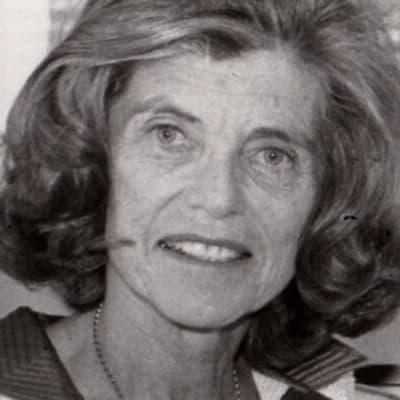
Eunice Kennedy Shriver
Children of Eunice Shriver (in birth order)
Full list with photos →Biography
Early Life
Eunice Mary Kennedy was born on July 10, 1921, in Brookline, Massachusetts, the fifth child of Joseph and Rose Kennedy. She was, by most accounts, the most driven and focused of all the Kennedy siblings — more organized than Jack, more idealistic than Bobby, more personally disciplined than Ted. Her faith, like her mother's, was deep and practical, less about ritual than about the obligation to serve.
She attended various Sacred Heart schools before graduating from Manhattanville College and earning a master's degree in sociology from Stanford University. She worked briefly at the State Department and in the Justice Department before shifting her focus to social work and advocacy.
The Inspiration of Rosemary
The defining private fact of Eunice Kennedy Shriver's life was her sister Rosemary, who had been born with intellectual disabilities, subjected to a lobotomy at age 23 on her father's orders, and subsequently institutionalized — a fact the Kennedy family kept secret for decades. Eunice knew the truth, and it transformed her.
Where her father's response to Rosemary had been concealment and removal, Eunice's response was advocacy and inclusion. She became convinced that the intellectual disability community had been systematically denied the opportunities available to everyone else — not because of incapacity, but because of stigma, institutional neglect, and a failure of social imagination.
Camp Shriver and the Path to Special Olympics
In 1962 Eunice converted the backyard of the family's Timberlawn estate in Rockville, Maryland into Camp Shriver, a day camp for children and adults with intellectual disabilities. She wanted to demonstrate, through direct experience, that this population was far more capable of athletic achievement than the dominant assumptions of the time allowed.
The camp was the direct precursor to the Special Olympics. On July 20, 1968, the first International Special Olympics Games were held at Soldier Field in Chicago, with roughly 1,000 athletes from 26 U.S. states and Canada competing in track and field and swimming events. The event was modest in scale but revolutionary in concept: it treated people with intellectual disabilities as athletes rather than patients, as participants rather than objects of charity.
Building a Global Movement
Over the following decades Eunice Kennedy Shriver built the Special Olympics into a global organization operating in more than 170 countries, with more than 5 million athletes participating annually. The organization changed not just individual lives but cultural norms — it was a principal driver of the deinstitutionalization movement and helped shift public attitudes toward intellectual disability from pity and exclusion toward respect and inclusion.
She received the Presidential Medal of Freedom in 1984 and the Congressional Gold Medal in 1998. She lobbied Congress persistently for increased funding for research into intellectual disabilities, helped establish the National Institute of Child Health and Human Development, and worked throughout her career to destigmatize both intellectual disability and mental illness.
She died on August 11, 2009, at Cape Cod Hospital in Hyannis, Massachusetts, fourteen days before her brother Ted. She was 88 years old.
Family Context
Eunice Kennedy Shriver is the late child of Joseph P. Kennedy Sr. and Rose Fitzgerald. They married R. Sargent Shriver Jr. and had 5 children: Robert Sargent Shriver III, Maria Shriver, Timothy Perry Shriver, Mark Kennedy Shriver, Anthony Paul Kennedy Shriver.
Related Kennedys
Frequently Asked Questions
Who founded the Special Olympics?
Eunice Kennedy Shriver founded the Special Olympics. She began with a backyard day camp for children with intellectual disabilities at her Maryland home in 1962, and organized the first International Special Olympics Games at Soldier Field in Chicago on July 20, 1968. The organization has since grown to operate in more than 170 countries.
How is Eunice Kennedy Shriver related to JFK?
Eunice Kennedy Shriver was the younger sister of President John F. Kennedy. She was the fifth of nine children born to Joseph P. Kennedy Sr. and Rose Fitzgerald Kennedy, making her part of the same Kennedy generation as JFK, Robert Kennedy, and Ted Kennedy. Her son Timothy Shriver now chairs the Special Olympics.
What inspired Eunice Kennedy Shriver to found the Special Olympics?
The primary inspiration was her sister Rosemary Kennedy, who was born with intellectual disabilities and was subjected to a lobotomy in 1941 at age 23, then institutionalized for the rest of her life. Eunice was deeply affected by Rosemary's experience and committed her life to ensuring that people with intellectual disabilities received the dignity, opportunity, and inclusion that Rosemary had been denied.