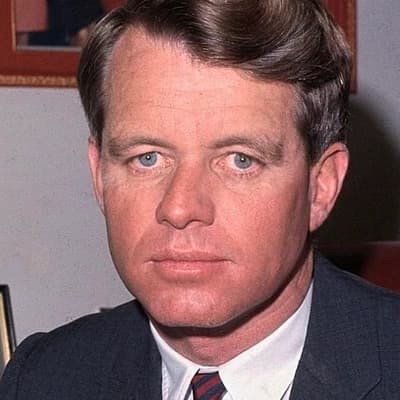
Robert F. Kennedy
Children of Robert Kennedy (in birth order)
Full list with photos →- 1.Kathleen Kennedy Townsendb. 1951Lt. Governor of Maryland (1995–2003)
- 2.Joseph P. Kennedy IIb. 1952U.S. Representative (MA-8, 1987–1999)
- 3.Robert F. Kennedy Jr.b. 1954U.S. Secretary of Health and Human
- 4.David Anthony Kennedy1955–1984
- 5.Mary Courtney Kennedyb. 1956Film Producer & Activist
- 6.Michael LeMoyne Kennedy1958–1997Nonprofit Director
- 7.Mary Kerry Kennedyb. 1959Human Rights Activist
- 8.Christopher George Kennedyb. 1963Businessman
- 9.Matthew Maxwell Taylor Kennedyb. 1965Author & Environmental Activist
- 10.Douglas Harriman Kennedyb. 1967Journalist & Television Reporter
- 11.Rory Elizabeth Katherine Kennedyb. 1968Academy Award–nominated Documentary
Biography
Early Life
Robert Francis Kennedy was born on November 20, 1925, in Brookline, Massachusetts, the seventh of nine children born to Joseph and Rose Kennedy. He was, by most accounts, the most intense and morally driven of the Kennedy siblings — a quality that served him in his later career as an enemy of corruption and a champion of the poor, but which in his youth made him seem by comparison with his gregarious older brothers somewhat stern and humorless.
He attended several schools before graduating from Milton Academy, then entered Harvard, where he was a hard-working but unremarkable student who played on the football team. He graduated in 1948 and earned his law degree from the University of Virginia School of Law in 1951.
Early Career and the McClellan Committee
After graduation Kennedy worked briefly as an attorney for the Justice Department before joining the staff of Senator Joseph McCarthy's Permanent Subcommittee on Investigations in 1953. His time with McCarthy, though brief — he resigned after six months over disagreements with McCarthy's chief counsel Roy Cohn — became a complicating footnote in his later liberal career.
His most consequential early work came when he served as chief counsel to the Senate Select Committee on Improper Activities in the Labor or Management Field, better known as the McClellan Committee. From 1957 to 1960, Kennedy relentlessly pursued corrupt union leaders, most famously Teamsters president Jimmy Hoffa. The two men developed a bitter personal enmity that endured for years, and Kennedy's pursuit of Hoffa as Attorney General was widely seen as the continuation of a personal vendetta as much as a prosecutorial principle.
Attorney General
When his brother was elected president in 1960, Robert Kennedy was appointed U.S. Attorney General — a choice widely criticized as nepotism. JFK's response became famous: 'I can't see that it's wrong to give him a little legal experience before he goes out to practice law.' Whatever the political optics, Robert Kennedy proved a formidable Attorney General.
He pushed the Justice Department to take a far more aggressive stance on civil rights than it had under the Eisenhower administration, dispatching federal marshals to protect Freedom Riders in Alabama in 1961 and federal troops to enforce the court-ordered integration of the University of Mississippi in 1962. He was also a central player in the Cuban Missile Crisis of October 1962, serving on the ExComm advisory group and advocating consistently for the diplomatic option over military escalation. His account of those thirteen days, published posthumously as Thirteen Days, remains one of the essential documents of the Cold War.
After Dallas
The assassination of his brother John in November 1963 shattered Robert Kennedy in ways that those close to him said never fully healed. He became visibly older, quieter, and more contemplative. He read extensively in Greek tragedy and in Camus. The loss also freed him from the role of loyal subordinate — he and Lyndon Johnson had always disliked each other intensely, and their relationship after the assassination was one of barely concealed mutual contempt.
Kennedy resigned as Attorney General in September 1964 and successfully ran for the U.S. Senate from New York, establishing a base independent of Johnson's White House. In the Senate he became an early critic of the Vietnam War, an advocate for the urban poor, and a voice for reconciliation between black and white America at a moment when that seemed nearly impossible.
The 1968 Campaign
Kennedy entered the 1968 presidential race on March 16, 1968, four days after Senator Eugene McCarthy had nearly defeated President Johnson in the New Hampshire primary. His late entry was criticized as opportunistic, but his campaign quickly gathered momentum as he swept through primary after primary. He was a galvanizing figure — crowds in Indiana, Nebraska, California reached levels of intensity that recalled his brother's campaigns.
On the night of April 4, 1968, Kennedy was in Indianapolis campaigning when he learned that Martin Luther King Jr. had been assassinated in Memphis. Against the advice of aides and local officials who feared for his safety, Kennedy went to a scheduled rally in a predominantly Black neighborhood and delivered, extemporaneously, one of the most moving speeches in American political history. Indianapolis was one of the few major American cities that did not riot that night.
By June 1968 the race had narrowed to Kennedy and McCarthy. On June 4, Kennedy won the California primary by roughly 46 percent to McCarthy's 42 percent. Shortly after midnight on June 5, he addressed supporters in the ballroom of the Ambassador Hotel in Los Angeles and left through the hotel kitchen.
Assassination
As Kennedy passed through the kitchen pantry of the Ambassador Hotel at approximately 12:15 a.m. on June 5, 1968, he was shot three times by Sirhan Bishara Sirhan, a 24-year-old Palestinian immigrant. Kennedy was hit in the right armpit, the right side of his neck, and, fatally, behind his right ear. He was rushed to Good Samaritan Hospital and died at 1:44 a.m. on June 6, 1968, at the age of 42.
Sirhan was arrested at the scene and later convicted of first-degree murder, a conviction he has unsuccessfully sought to overturn for decades. Conspiracy theories have persisted around the assassination, centering on acoustic evidence, eyewitness accounts, and the disputed trajectory of the bullets. A 2020 Los Angeles court hearing, supported by two of Kennedy's sons, reopened the case; the courts have so far declined to grant Sirhan a new trial.
Legacy
Robert Kennedy occupies a unique place in American political memory — the politician whose career most fully embodied the promise of redemption, the possibility that a person could genuinely change. The tough enforcer who once worked for McCarthy became the most compassionate voice in American liberalism; the loyal lieutenant who supervised wiretaps of Martin Luther King Jr. became, in the spring of 1968, perhaps the most trusted white politician in Black America.
His death, coming just two months after King's, felt to many Americans like the end of a particular kind of hope. His eleven children went on to careers in politics, law, environmental advocacy, and public service — a diaspora of Kennedy public life that continues into the present generation.
Family Context
Robert F. Kennedy is the late child of Joseph P. Kennedy Sr. and Rose Fitzgerald. They married Ethel Skakel and had 11 children: Kathleen Kennedy Townsend, Joseph P. Kennedy II, Robert F. Kennedy Jr., David Anthony Kennedy, Mary Courtney Kennedy, Michael LeMoyne Kennedy, Mary Kerry Kennedy, Christopher George Kennedy, Matthew Maxwell Taylor Kennedy, Douglas Harriman Kennedy, Rory Elizabeth Katherine Kennedy.
Related Kennedys
Frequently Asked Questions
How did Robert Kennedy die?
Robert F. Kennedy was shot by Sirhan Sirhan in the kitchen pantry of the Ambassador Hotel in Los Angeles, California, shortly after midnight on June 5, 1968, following his victory in the California Democratic presidential primary. He died the following morning, June 6, 1968, at the age of 42.
Who killed RFK?
Sirhan Bishara Sirhan, a 24-year-old Palestinian immigrant, was convicted of the murder of Robert Kennedy. He was arrested at the scene immediately after the shooting. Sirhan has remained imprisoned and has expressed hostility toward Kennedy's pro-Israel positions as his motive. Conspiracy theories about additional gunmen have circulated for decades but have not resulted in a new trial.
How many children did RFK have?
Robert F. Kennedy had eleven children with his wife Ethel Skakel Kennedy: Kathleen, Joseph II, Robert Jr., David, Mary Courtney, Michael, Mary Kerry, Christopher, Matthew Maxwell Taylor, Douglas, and Rory. Rory was born six months after her father's assassination.