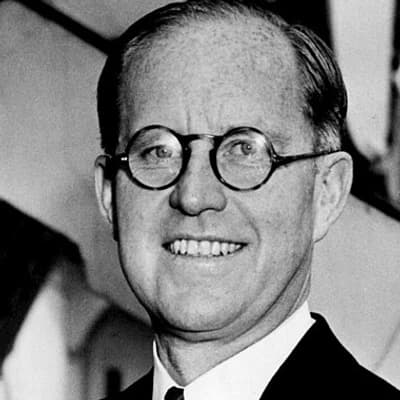
Joseph P. Kennedy Sr.
Children of Joseph Kennedy Sr. (in birth order)
Full list with photos →- 1.Joseph P. Kennedy Jr.1915–1944U.S. Navy Pilot
- 2.John F. Kennedy1917–196335th President of the United States
- 3.Rosemary Kennedy1918–2005Inspiration for Special Olympics
- 4.Kathleen 'Kick' Kennedy1920–1948Marchioness of Hartington
- 5.Eunice Kennedy Shriver1921–2009Founder of the Special Olympics
- 6.Patricia Kennedy Lawford1924–2006Socialite & Activist
- 7.Robert F. Kennedy1925–1968U.S. Attorney General
- 8.Jean Kennedy Smith1928–2020U.S. Ambassador to Ireland (1993–1998)
- 9.Edward 'Ted' Kennedy1932–2009U.S. Senator from Massachusetts
Biography
Early Life and Education
Joseph Patrick Kennedy was born on September 6, 1888, in East Boston, Massachusetts, the son of Patrick Joseph 'P.J.' Kennedy, a saloon owner and state legislator, and Mary Augusta Hickey. The family was comfortably positioned within Boston's Irish-Catholic community, and P.J.'s political connections gave young Joseph an early education in the relationship between money and power.
Kennedy attended Boston Latin School, one of the oldest public schools in the country, before earning admission to Harvard University, where he graduated in 1912 with a degree in economics. His Harvard years were socially ambitious but not academically distinguished; what mattered most to him was the world of business, which he entered almost immediately after graduation.
Building a Fortune
Kennedy's ascent in business was rapid and relentless. At just 25, he became president of Columbia Trust, a small East Boston bank, making him one of the youngest bank presidents in Massachusetts. During World War I he managed the Bethlehem Steel shipyard in Quincy, gaining experience in large-scale industrial management.
In the 1920s he turned to Hollywood, acquiring and consolidating several motion picture companies, eventually gaining control of Film Booking Offices of America (FBO) and merging it into what became RKO Pictures. He also became romantically involved with actress Gloria Swanson, an affair that continued for several years. Kennedy sold his Hollywood interests near the peak of the market in 1928, walking away with tens of millions of dollars before the Great Crash of 1929.
His stock market activities during this period remain controversial. Kennedy was a sophisticated investor who was aware of widespread speculation and manipulation in the bull market of the late 1920s. Whether he engaged in pool operations — coordinated schemes to artificially inflate and then dump stocks — has been debated by historians, but his reputation as a sharp and sometimes ruthless operator was well established by the time he left Hollywood.
Public Service and the Ambassadorship
Kennedy was an early and financially significant supporter of Franklin D. Roosevelt's 1932 presidential campaign, and he was rewarded with appointment as the first chairman of the newly created Securities and Exchange Commission in 1934. The irony of a man with Kennedy's Wall Street background regulating the markets was not lost on critics, but Roosevelt's logic was sound: it takes a thief to catch a thief. Kennedy proved an effective chairman, stabilizing public confidence in the markets during a delicate period.
After a stint as chairman of the Maritime Commission, Kennedy received the appointment he had long coveted: U.S. Ambassador to the United Kingdom, taking up the post in 1938. His tenure in London became one of the most controversial in diplomatic history. Kennedy was a convinced appeaser, believing that war with Nazi Germany was both inevitable and catastrophic for the West. He maintained channels of communication with German officials that went beyond his brief, and his defeatist cables to Washington during the fall of France in 1940 — suggesting that democracy itself might be finished — infuriated Roosevelt. Kennedy resigned in November 1940, effectively ending his career as a public official.
The Kennedy Political Dynasty
The defeat of his own diplomatic ambitions only intensified Kennedy's determination to place his sons in positions of power. His eldest, Joseph Jr., was being groomed for the presidency when he was killed on a volunteer bombing mission over England in August 1944. The mantle then passed to John, and Kennedy channeled his considerable wealth, connections, and cunning into John's political career — from the 1946 congressional race through the 1960 presidential campaign.
Kennedy's methods were not always scrupulous. He spent lavishly on JFK's Senate races, worked his connections in the Catholic Church, and allegedly leveraged relationships with organized crime figures to secure labor union support in key states during the 1960 primary season. His role in JFK's 1960 victory against Richard Nixon was decisive, though John was careful to keep his father at a distance publicly.
He also engineered Robert Kennedy's appointment as Attorney General — a choice JFK initially resisted — and remained a powerful backstage force in the early months of his son's presidency.
Stroke and Final Years
On December 19, 1961, just eleven months into JFK's presidency, Joseph Kennedy suffered a massive stroke while playing golf in Palm Beach, Florida. He was left severely incapacitated, unable to speak intelligibly and largely paralyzed on his right side, though he retained his mental faculties and could understand everything around him.
Kennedy lived for nearly eight more years in this condition, witnessing from his wheelchair at the Kennedy compound in Hyannis Port the assassination of his son John in 1963, the assassination of Robert in 1968, and the humiliations of Chappaquiddick. Those who visited him in his final years said his eyes conveyed the depths of his grief. He died on November 18, 1969, at the age of 81.
Legacy
Joseph Kennedy's legacy is inseparable from the political dynasty he created. He turned a first-generation immigrant family into one of the most powerful political forces in American history, placing a son in the White House and another in the Senate for nearly five decades. His methods — the calculated use of wealth, the willingness to operate in moral gray areas, the absolute prioritization of family ambition — made him both admired and reviled.
Historians have also wrestled with his antisemitic remarks (preserved in diplomatic cables from London), his appeasement of Hitler, and his alleged connections to bootlegging during Prohibition, though the evidence for the last remains largely circumstantial. Whatever the final accounting, no serious history of twentieth-century American politics can be written without him.
Family Context
Joseph P. Kennedy Sr. is the founding patriarch/matriarch of the Kennedy family branch. They married Rose Fitzgerald and had 9 children: Joseph P. Kennedy Jr., John F. Kennedy, Rosemary Kennedy, Kathleen 'Kick' Kennedy, Eunice Kennedy Shriver, Patricia Kennedy Lawford, Robert F. Kennedy, Jean Kennedy Smith, Edward 'Ted' Kennedy.
Related Kennedys
Frequently Asked Questions
How did Joseph Kennedy Sr. make his money?
Joseph Kennedy made his fortune through a combination of banking, the stock market, the motion picture industry (including controlling interests in FBO and RKO Pictures), and real estate. He exited his Hollywood investments before the 1929 crash and was rumored to have profited from short-selling during the downturn. He also had significant real estate holdings in New York and Palm Beach.
Why did Joseph Kennedy Sr. resign as Ambassador to the United Kingdom?
Kennedy resigned as Ambassador in November 1940 after his defeatist cables to Washington — suggesting that Britain could not survive and that American intervention would be futile — became publicly embarrassing. His conversations with German officials also raised concerns in the Roosevelt administration about his loyalty to official U.S. policy. He and Roosevelt met one final time after his return, but Kennedy's diplomatic career was effectively finished.
Did Joseph Kennedy Sr. have mob connections?
The question of Kennedy's ties to organized crime is debated. He is often alleged to have been involved in bootlegging during Prohibition, though historians have not found definitive documentary evidence of direct mob partnerships. More concretely, it has been alleged that Kennedy, through intermediaries including Frank Sinatra, sought the help of Chicago Outfit boss Sam Giancana to deliver union votes in key states during the 1960 presidential campaign — an arrangement that became bitterly ironic when Robert Kennedy, as Attorney General, pursued the same mob bosses relentlessly.