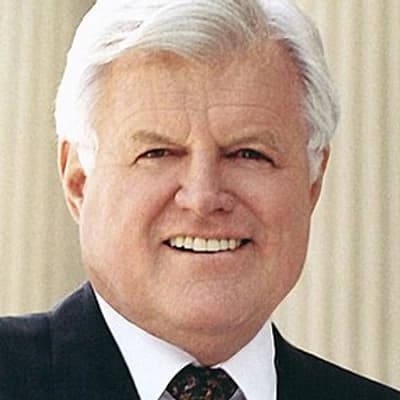
Edward 'Ted' Kennedy
Children of Ted Kennedy (in birth order)
Biography
Early Life
Edward Moore Kennedy was born on February 22, 1932, in Boston, Massachusetts, the youngest of Joseph and Rose Kennedy's nine children. Growing up in the shadow of older, more accomplished siblings, Ted developed the social ease and warmth that would later define his Senate career — the ability to work a room, to build personal connections across political lines, to make people feel genuinely heard.
He was asked to leave Harvard temporarily in 1951 after he arranged for a friend to take his Spanish examination for him, a transgression that became one of several embarrassments his family managed through the years. He enlisted in the Army, returned to Harvard, and graduated in 1956. He earned his law degree from the University of Virginia in 1959.
Entering the Senate
Kennedy ran for the U.S. Senate from Massachusetts in 1962, winning the seat that JFK had vacated when he became president. He was 30 years old — the minimum age for the position — and the race was widely viewed as an act of Kennedy family entitlement; the seat was being kept warm for him while JFK occupied the White House. He won comfortably and would hold it for nearly 47 years, the third-longest Senate tenure in American history.
He proved a more effective legislator than most had expected. He developed the patience for the grinding work of committee hearings and floor negotiations that his brothers never fully embraced. By the late 1960s he had established himself as a genuine Senate force, and after his brother Robert's assassination in 1968, many Democrats looked to him as the likely next Kennedy president.
Chappaquiddick
On the night of July 18–19, 1969, Kennedy drove off a bridge on Chappaquiddick Island, near Martha's Vineyard, Massachusetts. His passenger, 28-year-old Mary Jo Kopechne, a former campaign worker for Robert Kennedy, died in the submerged car. Kennedy escaped from the vehicle but did not report the accident to authorities until the following morning, some nine hours after it occurred.
Kennedy pled guilty to leaving the scene of an accident and received a two-month suspended sentence. His nationally televised explanation — in which he spoke of being 'deeply in shock' and 'made irrational' by the crash — satisfied few. The incident permanently damaged his presidential prospects and remained the defining liability of his public career for the next forty years. He never gave a fully satisfactory accounting of his actions that night.
The 1980 Presidential Run
Kennedy challenged sitting President Jimmy Carter for the Democratic nomination in 1980, a campaign that began with enormous promise and ended in defeat. An early television interview with Roger Mudd, in which Kennedy struggled to articulate a coherent answer to the simple question of why he wanted to be president, badly damaged his campaign from the start.
Despite winning several major primaries, Kennedy could not overtake Carter, who had the advantage of incumbency and the ongoing Iran hostage crisis. Kennedy's concession speech at the 1980 Democratic National Convention — 'The dream shall never die' — was widely considered the best speech of his career and demonstrated the full measure of what the presidency had lost.
Legislative Legacy
Kennedy's legislative record is, by almost any measure, the most consequential of any senator in the second half of the twentieth century. He was the Senate's most effective advocate for healthcare access, helping to create the Children's Health Insurance Program (CHIP), expand Medicaid, and pass the COBRA legislation that allows workers to maintain health coverage between jobs. He was a lead sponsor of the Americans with Disabilities Act of 1990, the Family and Medical Leave Act of 1993, and the Mental Health Parity Act of 2008.
He worked across the aisle with Republican colleagues on major legislation at moments when bipartisan cooperation seemed impossible — notably with George W. Bush on the No Child Left Behind education act in 2001 and on immigration reform efforts throughout the 2000s. He co-sponsored the Hate Crimes Prevention Act, immigration reform bills, and dozens of other major pieces of legislation. His willingness to negotiate, to give as well as take, made him effective in ways that purists found frustrating but pragmatists recognized as essential.
Final Years and Death
In May 2008 Kennedy was diagnosed with a malignant brain tumor, a glioblastoma multiforme — the same type of cancer that would later claim John McCain. Despite the diagnosis, he appeared at the 2008 Democratic National Convention to endorse Barack Obama in an appearance that brought the hall to its feet and was widely understood as a passing of a torch. He returned to the Senate floor in July 2008 to cast a crucial vote on Medicare physician reimbursement rates, receiving a standing ovation.
Kennedy died on August 25, 2009, at his home in Hyannis Port, Massachusetts, surrounded by family. He was 77. His funeral mass at the Basilica of Our Lady of Perpetual Help in Boston was attended by three living former presidents and the incumbent president.
The Lion of the Senate
The epithet 'The Lion of the Senate' — first used by colleagues and later adopted universally — captured both his power and his style. Kennedy was the Senate's most skilled floor debater and one of its most effective coalition builders. He understood the institution in its bones: its procedures, its loyalties, its capacity for both inspiration and obstruction.
But the lion metaphor also suggests something of the pathos of his career — the sense of a creature suited for the jungle rather than the drawing room, a man who might have been president but whose private failings confined him to the Senate. Whatever the verdict on his character, his legislative record stands as one of the most consequential in the history of the institution.
Family Context
Edward 'Ted' Kennedy is the late child of Joseph P. Kennedy Sr. and Rose Fitzgerald. They married Virginia Joan Bennett, Victoria Reggie and had 3 children: Kara Anne Kennedy, Edward Moore Kennedy Jr., Patrick J. Kennedy II.
Related Kennedys
Frequently Asked Questions
What happened at Chappaquiddick?
On July 18–19, 1969, Ted Kennedy drove his car off the Dike Bridge on Chappaquiddick Island in Massachusetts. His passenger, Mary Jo Kopechne, drowned in the submerged vehicle. Kennedy escaped but did not report the accident to police until the following morning, roughly nine hours later. He pled guilty to leaving the scene of an accident and received a two-month suspended sentence. The incident was widely seen as the primary reason he never won the presidency.
What laws did Ted Kennedy pass?
Ted Kennedy's legislative legacy is among the most substantial in Senate history. Major legislation he sponsored or co-sponsored includes the Americans with Disabilities Act (1990), the Family and Medical Leave Act (1993), the Children's Health Insurance Program (CHIP), COBRA health coverage continuation, the Mental Health Parity Act (2008), the Hate Crimes Prevention Act, and key portions of No Child Left Behind (2001). He served on the Health, Education, Labor and Pensions Committee for decades.
Why was Ted Kennedy called the Lion of the Senate?
The nickname 'Lion of the Senate' referred to Kennedy's commanding presence as a legislative force — his skill at floor debate, his ability to build bipartisan coalitions, and his decades of effective advocacy for healthcare, civil rights, and workers. He served in the Senate from 1962 until his death in 2009, a tenure of nearly 47 years, and became the standard-bearer of American liberalism across multiple generations.